

Much like Fiji, New Zealand was never on my list. Neither was Australia. Both felt too familiar, too Western, too much like the U.S. Why, I wondered, would I fly halfway around the world for what I imagined was just California with more sheep?
To be even more honest, I hadn’t thought about New Zealand enough to reject it. I just lumped it in with Australia, like a forgotten second cousin at a family reunion.
There were too many other places between home and the South Pacific that pulled harder: Malaysia, Indonesia, Thailand – places I expected to overwhelm me with difference, to jolt me awake.
But here I am.
I’ve been to more than fifty countries, and as I set off on this next chapter, trying to sort out what the second half of my life should look like, I worried that I’d broken something in myself. That I’d seen too much. That maybe I was no longer capable of the kind of awe that makes travel matter. I even said that out loud to a friend just before I landed here.
At first, that fear felt justified. Driving out of Christchurch, I saw snowcapped peaks on the horizon. Pretty, sure, but it reminded me of driving out of Salt Lake City toward the Wasatch Range. Ho hum, I thought. Been there, seen that.
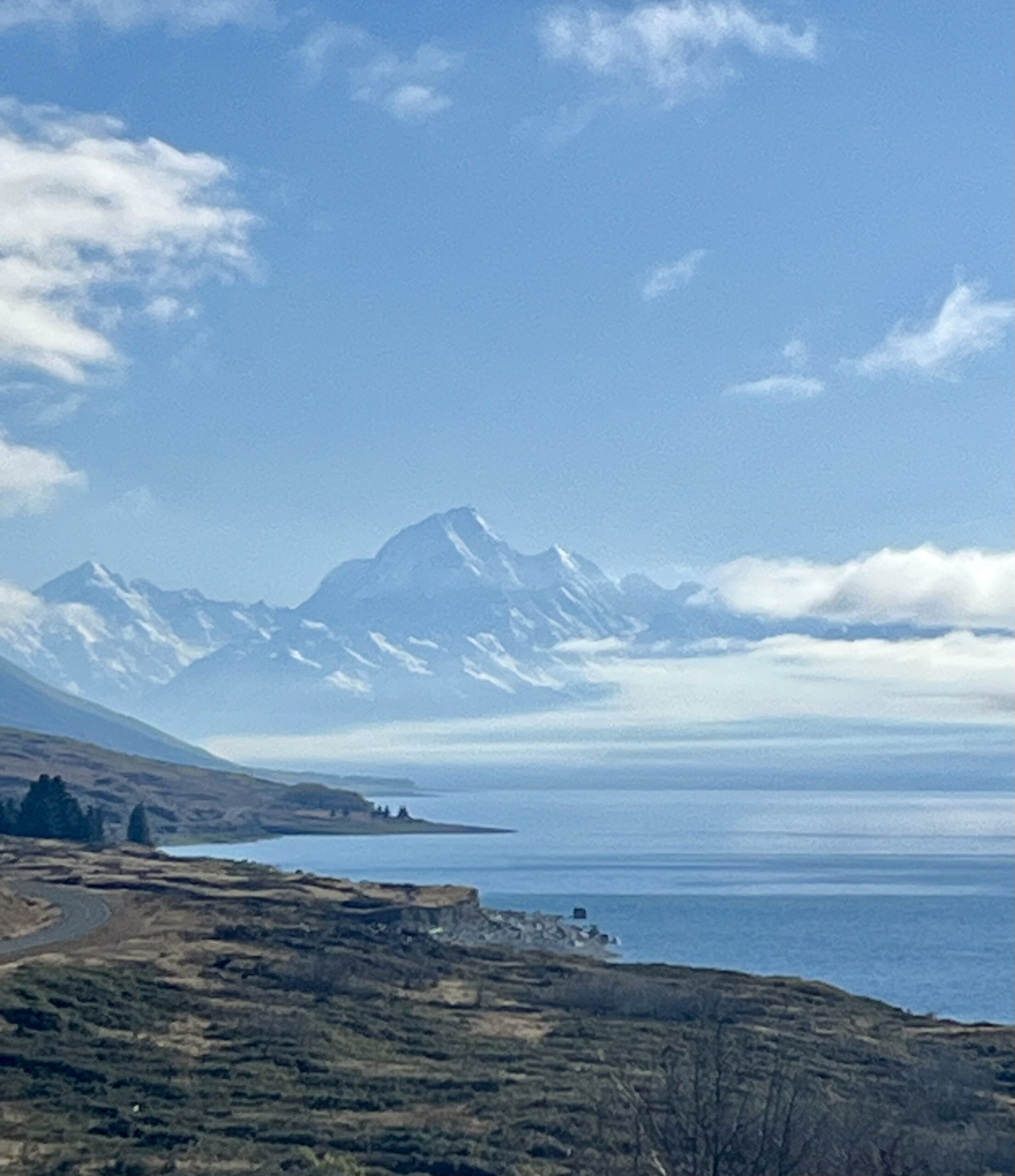
And then Lake Tekapo appeared, its waters glowing an impossible shade of blue, ringed by mountains sharp with snow. Something stirred. A little closer.
Then Aoraki / Mt. Cook rose from the mist, shrouded in clouds, looking more like a stage backdrop than anything real. Suddenly I understood why they call these the Southern Alps.
The surprises kept stacking up:
• Lakes shimmering turquoise and green, reflecting jagged peaks like giant mirrors.
• Perfectly round boulders scattered across a beach, as if some long-forgotten giant had dropped his marbles.
• And finally, Milford Sound, improbable cliffs plunging into dark waters, waterfalls streaking silver down their faces, a cathedral of stone and mist so dramatic it felt almost otherworldly.
Here, the landscapes tilt toward the mythic: geothermal pools steaming like cauldrons, coastlines carved with drama, mountains rising straight from storybooks. The air itself feels younger, cleaner, somehow less worn down by centuries of industry.
And then there’s the culture: layered, complicated, unapologetically its own. The Māori presence doesn’t sit in the background like a museum piece; it pulses through language, art, and daily life. That alone makes this place unlike anywhere I’ve been.
Back in the U.S., the only real glimpse most of us get of Māori culture is the haka, powerful, yes, but viewed through a narrow lens that often projects aggression, dominance, and hyper-masculinity, not unlike our own culture. But once you actually meet Māori people, that assumption dissolves.
What I’ve found instead is a culture built on balance. Men and women standing on equal ground, not one above the other. And the men themselves, many built like rugby forwards, some former military, others CrossFit strong, carry a gentleness that surprises me. Not soft, but steady. Grounded. Strong in a way that doesn’t rely on dominance to prove itself.
At its center, Māori life revolves around family, community, and connection, threads that seem to anchor every interaction. It’s a way of being together that feels increasingly rare where I come from.
I once remember a school kid in Tanzania asking if America had “tribes” like the 120 or so in his country. I said no, then caught myself, realizing how easily I’d erased the hundreds of Native American nations my own government had spent centuries trying to eradicate. In New Zealand, by contrast, Te Tiriti o Waitangi, the Treaty of Waitangi signed between Māori and the British Crown in 1840, still lives. It remains the foundation of Māori sovereignty and coexistence, even as today’s right-wing government works to undercut it.
New Zealand is not the U.S. in disguise. It is not Australia’s little sibling. And it is certainly not forgettable. From my first day here, I felt that rare mix of comfort and awe, the kind that makes you wonder how you could have overlooked it for so long.
What it gave me was proof that I’m still capable of wonder. And my sincere apologies to the Kiwis for the ignorant dismissal.