
April 19, 2025
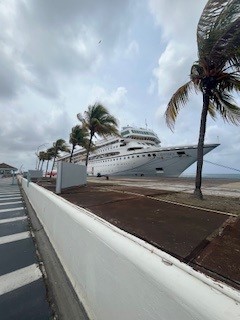
Imagine if a cruise ship, a retirement community, and an Apple new product launch collided mid-ocean. That’s Ville Vie Residences—billed as the first-of-its-kind, liveaboard, circumnavigation cruise ship community – currently gliding somewhere between utopian vision and sociological experiment. It’s an all ages (though not surprisingly primarily 55+) life-at-sea concept that swaps fleeting port calls for multi-day immersions, turning the standard vacation cruise model into something closer to nomadic semi-permanence.
I boarded for a week as a “try-before-you-buy” guest – no title, no name tag, and definitely no status. Just a curious interloper sampling the waters. Above me on the officially unofficial social ladder are the “segmenters,” folks who’ve committed to segments of the voyage in specific geographic areas of the world. Higher up the rungs are the “owners” and “founders.” But the top echelon are the “investors” who see the vision for the future in a nomadic world, many of whom carry the air of early adopters at a tech launch.
Instead of introductions anchored by jobs like back in the “real world,” introductions here are formalized by affiliation. “Hi, I’m Janet, founder, been here since Belfast.” “I’m Mark, investor, got on in October.” The hierarchy is unspoken but unmistakable—something between Burning Man and a gated HOA with better ocean views.
The week I joined, the founders—Mike and Cathy—were aboard, and their evening presentation drew a crowd reminiscent of an Apple product launch or the early days of Tesla. There was the same reverent hush, the same wide-eyed admiration, and just a hint of cultish devotion as their introduction was met with cheers and hurrahs. These weren’t just residents applauding a speech—they were believers cheering on a vision.
Ville Vie’s origin story only deepens the mythos. Mike and Cathy originally worked for a different company aiming to launch a similar at-sea residential concept—but that venture never even made it off the dock. When it sank (along with everyone’s investment), they decided to chart their own course. (Yes, yes, I know. The nautical puns are piling up like barnacles. But hey, I’m almost at the bitter end.) The ship was originally slated to set sail in May 2024, but delays in dry dock pushed launch to October 2024. Depending on who you ask, that five-month setback was either a major misstep, a necessary rite of passage, or just a minor squall on the way to full-time floating bliss.
What’s life like on board? Having never actually been on a traditional cruise, I didn’t have much to compare it to. I did a transatlantic crossing during Sabbatical I, but that was on a sailboat which was… not the same. This? This is something else. There’s a rhythm to life on the Odyssey, maybe several, depending on your interests.
For me, days started much like they did at home: up around 5 a.m., with coffee already waiting (small mercies), and time to catch up on the previous day’s political chaos. A light breakfast, then off to play pickleball. Yes, you read that right, pickleball at sea (or in port). Or as I like to call it: pickleboat. Afterward, there was usually something going on, whether its a resident-led talk on a niche passion, a book club, or an exercise class. Then it was lunch, followed by gym time for me, maybe a little work, then reading, writing, and researching the next port of call. Dinner, some downtime, a little TV or more reading. But social life onboard is a choose-your-own-adventure. Some folks always ate solo, some were constantly in groups. WhatsApp groups abound for nearly every interest and identity. While I was there, the Jewish residents organized a Passover celebration, others made plans to attend Easter services ashore. There were art classes, stretching sessions, Pilates. There’s a laundry for residents, a spa for massages and facials, a golf simulator is on the way as are Peloton bikes and, of course, pools and Jacuzzi’s up top. It’s part small town, part community center, just floating – wherever we were on the map that day.
What’s striking is how these pioneers, people who’ve made wildly outside-the-box decisions to uproot their lives and live on a floating experiment, are still grappling with the most mundane logistical headaches. Cocktail hour conversations toggle between strategies for maximizing shore time and the ongoing saga of transferring prescriptions between U.S. pharmacies. It’s a reminder that even aboard a vessel engineered for reinvention, you don’t entirely escape the everyday. You just troubleshoot it in linen pants.
And that’s what makes the occasional, sotto voce displeasure expressed among residents about the initial delay and ongoing hiccups feel a bit out of sync with reality. For anyone who’s ever launched a startup, and I get that’s not most folks, the logistics of this operation are staggering. Ensuring you can get everything from toilet paper to engine parts, fresh produce to laundry detergent, an endless supply of wine and spirits to the right volume of fuel at the right price, is a feat of daily improvisation. Not to mention setting up all of the ports of call for a new cruise, the paperwork and permits and visas, and on and on and on. That Mike and Cathy are pulling this off on a shoestring budget with a skeleton crew is kind of miraculous. I found myself a little surprised by the lack of generosity in some of the grumbling when the residents were struggling with the most basic logistical hurdles. Then again, people are always gonna people and I hadn’t sold off everything I owned in search of utopia, only to find myself stranded in Belfast for six months. (To be really fair, Ville Vie apparently sent everyone off on a series of adventures to tide them over, other cruises, excursions, putting them up in hotels – the additional logistics and costs are mind-boggling.
But now that they’re finally underway, Ville Vie feels less like a cruise and more like a movement. The folks on board are true believers, many with no intention of ever returning to dry land—or at least bought in for the next 15 years. Whether it becomes a model for future living or a fascinating blip in the annals of alternative retirement remains to be seen. But from the shuffleboard courts to the onboard wine tastings, something’s clearly afloat—part reinvention, part retirement, and entirely unlike anything else at sea.